 Obverse
 Reverse
United Kingdom · 91.67% gold
British Gold Five Pounds (Quintuple Sovereign) 1820–present
The gold five pounds, or quintuple sovereign, is a British 22-carat gold coin issued intermittently since 1820.
Issued intermittently, mostly in proof or coronation sets: 1820 (pattern), 1826, 1829, 1839, 1887, 1893, 1902, 1911, 1937, 1953, 1957, 1980–1982 and yearly from 1984.
Melt value today
$4,547.15
- Face value
- £5
- Gold content
- 1.1771 oz
- Gold spot
- $3,862.90 /oz
Live spot · Metals.dev
How this melt value is calculated
- 1. Gold in the coin39.94 g × 0.9167 ÷ 31.1034768 = 1.1771 oz (36.613 g pure gold)
- 2. Gold price$3,862.90 per troy ounce
- 3. Melt value1.1771 oz × $3,862.90 = $4,547.15
Premium evaluator
Enter the price a dealer is asking to compare it with the melt value of $4,547.15 per coin.
Build a stack to total your gold and silver. Stored only in this browser.
About the British Gold Five Pounds (Quintuple Sovereign)
The five-pound piece is struck to five times the weight of the sovereign in the same 22-carat gold. It first appeared as a pattern in 1820 and was issued in small numbers in the 1820s; the 1839 issue is the 'Una and the Lion' coin.
Pistrucci's St George and the Dragon returned for the Jubilee coinage of 1887, followed by 1893 and the coronation years 1902, 1911 and 1937. Modern issues began in 1980 and have been struck yearly since 1984; several were issued only in sovereign proof sets.
Gold five-pound crowns (commemorative coins) are a separate series. Royal Mint retail listings round the weight of the 1887 coin to 39.90 g; the standard is five sovereigns, 39.94 g.
How to identify it
- Obverse: portrait of the monarch. Reverse: usually St George and the Dragon with the date beneath; the 1839 coin shows Una and the Lion.
- About 36 mm across and 39.94 g, five times the weight of a sovereign.
- An S mint mark marks Sydney Mint coins of 1887 and 1902.
- Cupronickel £5 crowns are silver-coloured and contain no gold.
Quick identification & value
- How much gold is in a gold five-pound coin?
- 1.1771 troy ounces (36.61 g) of pure gold in a coin weighing 39.94 g of 22-carat gold.
- Is a quintuple sovereign the same as a £5 crown?
- No. The quintuple sovereign is a 22-carat gold coin on the sovereign standard. Ordinary £5 crowns are cupronickel commemoratives.
- Is melt value the same as collector value?
- No. Melt value is only the value of the gold. Scarce dates, mint marks and well-preserved examples can sell for much more to collectors, while a dealer buying for gold content may offer somewhat less than melt.
- Does circulation wear affect the value?
- Slightly. The figures here use the official weight when struck. Heavily worn coins have lost a little metal, so their real gold content is modestly lower — and wear usually matters far more to collector value.
Related coins and tools
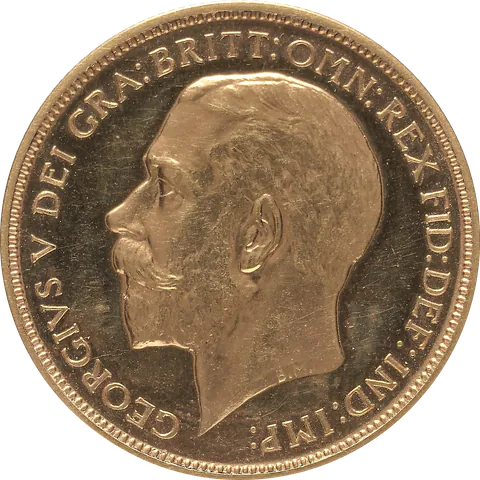
British Gold Double Sovereign (£2)
1820–present0.4709 oz Au
$1,818.86Face value £2
Gold Britannia 1 oz
1987–20121.0000 oz Au
$3,862.93Face value £100
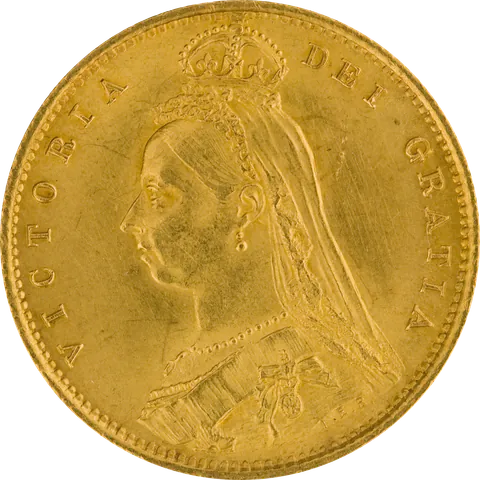
British Gold Half Sovereign
1817–present0.1177 oz Au
$454.71Face value ½ pound (50p)
Gold Britannia 1 oz
2013–present1.0000 oz Au
$3,862.90Face value £100
Sources & methodologyThe Royal Mint, Numista, Wikipedia
Specifications verified against
- Wikipedia: Five pounds (gold coin)Mass 39.94 g; .917 gold (22 carat); 1.1771 troy oz; 36.02 mm; years of issue
- Numista: 5 Pounds - Victoria (2nd portrait) - United Kingdom1887: gold .9167, 39.94 g, 36.0 mm
- Numista: 5 Pounds - Edward VII - United Kingdom1902: 39.94 g
- The Royal Mint: 1887 Victoria Gold Five Pounds (Quintuple) Sovereign22-carat alloy, 36.00 mm; lists the weight as 39.90 g
Method
Melt values are calculated from these specifications and the price of gold and the other metals in its alloy; no value is stored or copied from another site. See the methodology and data sources.