 Obverse
 Reverse
Netherlands · 98.3% gold
Dutch Gold Ducat 1817–present
The Kingdom of the Netherlands gold ducat is a trade coin of 3.494 g in .983 gold, about 3.43 g or 0.110 troy ounces of fine gold, struck since 1817.
Struck to the standard of the coinage law of 28 September 1816 from 1817; the Royal Dutch Mint still issues it, now as a proof coin.
Melt value today
$427.12
- Face value
- None
- Gold content
- 0.1104 oz
- Gold spot
- $3,867.96 /oz
Live spot · Metals.dev
How this melt value is calculated
- 1. Gold in the coin3.494 g × 0.983 ÷ 31.1034768 = 0.1104 oz (3.435 g pure gold)
- 2. Gold price$3,867.96 per troy ounce
- 3. Melt value0.1104 oz × $3,867.96 = $427.12
Premium evaluator
Enter the price a dealer is asking to compare it with the melt value of $427.12 per coin.
Build a stack to total your gold and silver. Stored only in this browser.
About the Dutch Gold Ducat
The coinage law of 1816 kept the gold ducat as a trade coin of the new Kingdom but set a slightly lower standard than the provincial ducat: 3.494 g at .983 fine, against 3.515 g at .986 before. The first ducats of the Kingdom type are dated 1817.
The obverse keeps the standing knight with a sword and a bundle of arrows and the shortened CONCORDIA legend. The reverse tablet now reads MO. AUR. REG. BELGII AD LEGEM IMPERII, gold coin of the Kingdom of the Netherlands according to the law of the Empire.
The Royal Dutch Mint at Utrecht still strikes the single ducat to this standard. In 2018 it introduced a new knight based on the work of Johan Willem Marmé, engraver of the Utrecht mint from 1763 to 1795.
Varieties
- Kingdom knight (1817–2017)The slimmer knight of the Kingdom ducat; a new knight appeared in 1986, and the 2017 anniversary issue used the older knight of 1817–1986.
- Marmé knight (2018–present)A new knight based on the work of Utrecht engraver Johan Willem Marmé (1763–1795), introduced with a four-year series on the ducat's trade routes.
How to identify it
- The reverse tablet reads MO. AUR. REG. BELGII AD LEGEM IMPERII; a tablet reading MO. ORD. PROVIN. FOEDER. BELG. AD LEG. IMP. marks the older, slightly finer provincial ducat.
- The obverse shows a standing knight with sword and arrows, the date split by the knight.
- Diameter 21 mm and a weight of about 3.49 g.
- There is no denomination in gulden or euros on the coin.
Quick identification & value
- How much gold is in a Dutch ducat?
- Since 1817 it has weighed 3.494 g at .983 fineness, so it contains about 3.43 g or 0.110 troy ounces of fine gold.
- Has the Dutch ducat always had the same gold content?
- Nearly. Ducats struck from 1586 to 1816 were 3.515 g at .986 fine; the 1816 coinage law lowered this to 3.494 g at .983 from 1817.
- Does a ducat have a face value?
- No. It was a trade coin valued by its gold content, not a denomination of the gulden.
- Is melt value the same as collector value?
- No. Melt value is only the value of the gold. Scarce dates, mint marks and well-preserved examples can sell for much more to collectors, while a dealer buying for gold content may offer somewhat less than melt.
- Does circulation wear affect the value?
- Slightly. The figures here use the official weight when struck. Heavily worn coins have lost a little metal, so their real gold content is modestly lower — and wear usually matters far more to collector value.
Related coins and tools
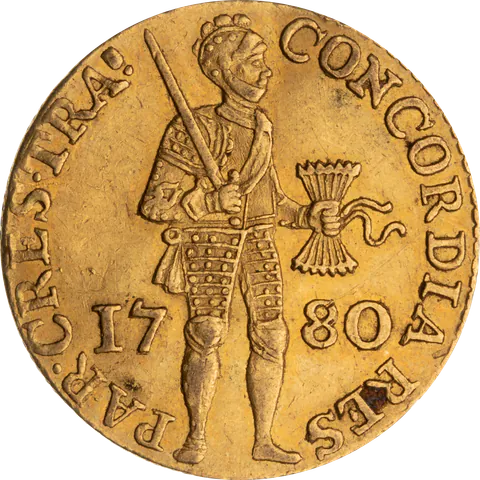
Dutch Gold Ducat, United Provinces Type
1586–18160.1114 oz Au
$431.00No face value
Dutch Double Gold Ducat
1988–present0.2209 oz Au
$854.24No face value
Dutch 5 Gulden Gold
19120.0972 oz Au
$376.06Face value 5 gulden
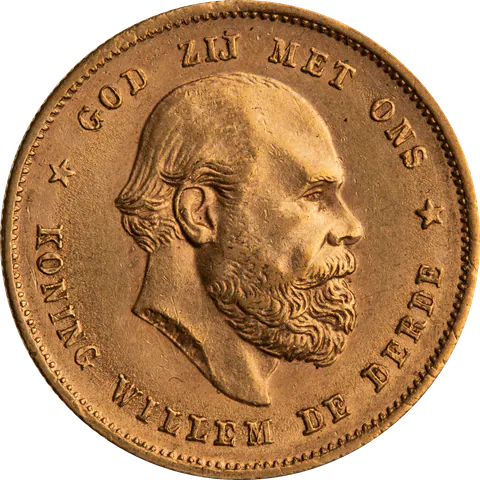
Dutch 10 Gulden Gold (Tientje)
1875–19330.1944 oz Au
$752.12Face value 10 gulden
Sources & methodologyRoyal Dutch Mint, NGC, Numista
Specifications verified against
- Wikipedia: DucatKingdom of the Netherlands continued the ducat after Napoleon; reverse tablet MO. AUR. REG. BELGII AD LEGEM IMPERII
- Royal Dutch Mint: Single Golden Ducat 2024Content 983/1000, weight 3.494 g, diameter 21 mm
- Royal Dutch Mint: Golden ducatsReverse inscription MO. AUR. REG. BELGII AD LEGEM IMPERII; Act of 4 August 1586; new knight after J. W. Marmé from 2018
- Numista: 1 Ducat - Willem I (Trade Coinage), Netherlands1817–1840, gold .983, 21 mm, reverse MO. AUR. REG. BELGII AD LEGEM IMPERII
- Numista: 1 Ducat (Trade Coinage), NetherlandsGold .983, 3.494 g, 21 mm, 0.110 oz gold
- NGC: Netherlands Ducat KM 50.1 (1817–1840)Fineness 0.9830, 1817–1840
- Koninklijk Nederlands Genootschap voor Munt- en Penningkunde (Jaarboek 2018): Jaarboek voor Munt- en Penningkunde 2018 (Jasek, Dutch gold ducats)Legal fineness 0.983 since 1817 (0.986 for 1586–1816)
Method
Melt values are calculated from these specifications and the price of gold and the other metals in its alloy; no value is stored or copied from another site. See the methodology and data sources.
Image
- Obverse and reverse: American Numismatic Society, 1971.346.12 (Gold ducat of William III, Utrecht, 1849). Public domain. Source · Public domain
- Background removed and resized; otherwise unaltered.