 Obverse
 Reverse
Germany · 62.5% silver
German 2 Reichsmark Silver 1933–1939
The German 2 Reichsmark of 1933–1939 weighs 8 g in .625 silver, which is 5 g (0.1608 troy oz) of fine silver.
Martin Luther 1933, Potsdam Garrison Church and Friedrich Schiller 1934, Hindenburg 1936–1939. Earlier 2 Reichsmark coins were not checked and are not covered.
Melt value today
$7.63
- Face value
- 2 Reichsmark
- Silver content
- 0.1608 oz
- Silver spot
- $47.22 /oz
Live spot · Metals.dev
silver $7.59 + copper (37.5%) $0.0402
How this melt value is calculated
- 1. Silver in the coin8.00 g × 0.625 ÷ 31.1034768 = 0.1608 oz (5.000 g pure silver)
- 2. Silver price$47.22 per troy ounce
- 3. Silver value0.1608 oz × $47.22 = $7.59
- 4. Copper value3.000 g ÷ 453.59237 g per lb × $6.08 = $0.0402
- 5. Melt value$7.59 + $0.0402 = $7.63
Premium evaluator
Enter the price a dealer is asking to compare it with the melt value of $7.63 per coin.
Build a stack to total your gold and silver. Stored only in this browser.
About the German 2 Reichsmark Silver
From 1933 the 2 Reichsmark was struck at 8 g in .625 silver, 25 mm across. The types are the Martin Luther commemorative of 1933, the Potsdam Garrison Church and Friedrich Schiller coins of 1934, and the Hindenburg circulation coin of 1936–1939.
All of these share the same weight and fineness. The 5 Reichsmark of the same period is a different alloy (.900).
How to identify it
- Hindenburg type: an eagle above a swastika within a wreath on one side and a large head of Paul von Hindenburg facing right on the other.
- Garrison Church type: the Garrison Church in Potsdam. Luther type: lettered MARTIN LUTHER 1483 - 1933.
- 25 mm across and 8 g; the 5 Reichsmark is 29 mm and 13.88 g.
Quick identification & value
- How much silver is in a 2 Reichsmark from 1933 to 1939?
- 8 g at 62.5% silver, which is 5 g or 0.1608 troy oz of fine silver.
- Is it the same alloy as the 5 Reichsmark?
- No. The 2 Reichsmark is .625 silver; the 5 Reichsmark of 1934–1939 is .900.
- Is melt value the same as collector value?
- No. Melt value is only the value of the silver. Scarce dates, mint marks and well-preserved examples can sell for much more to collectors, while a dealer buying for silver content may offer somewhat less than melt.
- Does circulation wear affect the value?
- Slightly. The figures here use the official weight when struck. Heavily worn coins have lost a little metal, so their real silver content is modestly lower — and wear usually matters far more to collector value.
Related coins and tools
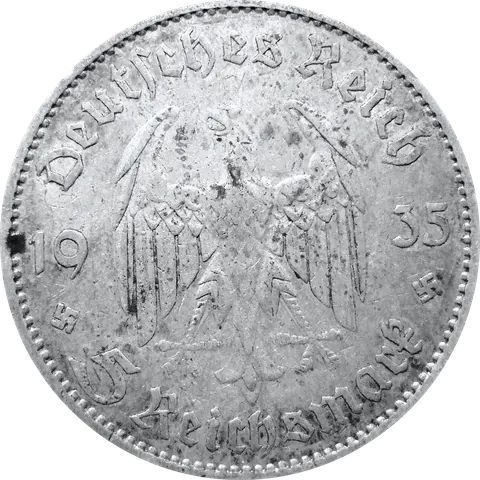
German 5 Reichsmark Silver
1934–19390.4016 oz Ag
$18.98Face value 5 Reichsmark
German Empire 5 Mark Silver
1874–19150.8038 oz Ag
$37.99Face value 5 marks
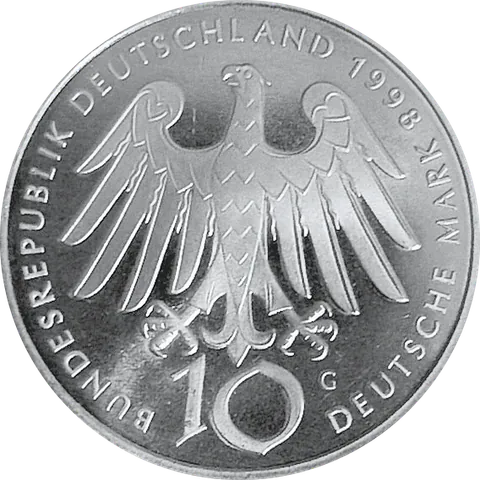
German 10 Deutsche Mark Silver Commemorative
1998–20010.4610 oz Ag
$21.78Face value 10 DM
German Empire 3 Mark Silver
1908–19180.4823 oz Ag
$22.79Face value 3 marks
Sources & methodologyNGC, Numista, Wikipedia
Specifications verified against
- NGC: Germany - Third Reich 2 Reichsmark KM 93 Prices & ValuesFineness 0.6250, 8.0000 g, ASW 0.1608 oz, 25 mm
- Numista: 2 Reichsmark (Paul von Hindenburg), Germany1936–1939: silver .625, 8 g, 25 mm
- Numista: 2 Reichsmark (Potsdam Garrison Church), Germany1934: silver .625, 8 g, 25 mm
- Numista: 2 Reichsmark (Martin Luther), Germany1933: same metal and dimensions
- Wikipedia: Reichsmark2 Reichsmark coin depicting Paul von Hindenburg (no weights given)
Method
Melt values are calculated from these specifications and the price of silver and the other metals in its alloy; no value is stored or copied from another site. See the methodology and data sources.