 Obverse
 Reverse
Canada · 90% gold
Canadian $10 Gold 1912–1914
Canada's George V ten-dollar gold coin, struck for circulation at Ottawa from 1912 to 1914 in .900 gold and containing 0.4838 troy ounces of gold.
Melt value today
$1,871.19
- Face value
- $10
- Gold content
- 0.4838 oz
- Gold spot
- $3,867.96 /oz
Live spot · Metals.dev
gold $1,871.17 + copper (10%) $0.0224
How this melt value is calculated
- 1. Gold in the coin16.7185 g × 0.9 ÷ 31.1034768 = 0.4838 oz (15.047 g pure gold)
- 2. Gold price$3,867.96 per troy ounce
- 3. Gold value0.4838 oz × $3,867.96 = $1,871.17
- 4. Copper value1.672 g ÷ 453.59237 g per lb × $6.07 = $0.0224
- 5. Melt value$1,871.17 + $0.0224 = $1,871.19
Premium evaluator
Enter the price a dealer is asking to compare it with the melt value of $1,871.19 per coin.
Build a stack to total your gold and silver. Stored only in this browser.
About the Canadian $10 Gold
The Currency Act of 1910 provided for Canadian gold coins. Only the $5 and $10 were issued, struck at the Ottawa branch of the Royal Mint (now the Royal Canadian Mint) from 1912 to 1914. Production stopped with the outbreak of the First World War.
The $10 is the same size as the United States eagle of the period and contains the same amount of gold.
More than 245,000 of the $5 and $10 coins were held by the Bank of Canada until 2012, when 30,000 were offered for sale and the rest were to be melted.
How to identify it
- Obverse: King George V. Reverse: the shield from the Canadian coat of arms, with the denomination of ten dollars and the date.
- Dated 1912, 1913 or 1914 only.
- About 26.9 mm across and 16.72 g, with a reeded edge.
Quick identification & value
- How much gold is in a Canadian $10 gold coin?
- 0.4838 troy ounces: 16.72 g of .900 gold.
- Is it the same as a U.S. $10 eagle?
- It is a different coin, but it was made to the same size and gold content as the U.S. eagle of the time.
- Is melt value the same as collector value?
- No. Melt value is only the value of the gold. Scarce dates, mint marks and well-preserved examples can sell for much more to collectors, while a dealer buying for gold content may offer somewhat less than melt.
- Does circulation wear affect the value?
- Slightly. The figures here use the official weight when struck. Heavily worn coins have lost a little metal, so their real gold content is modestly lower — and wear usually matters far more to collector value.
Related coins and tools
Canadian $5 Gold
1912–19140.2419 oz Au
$935.59Face value $5
Canadian Gold Maple Leaf 1 oz
1983–present1.0000 oz Au
$3,867.96Face value $50
Canadian Gold Maple Leaf 1 oz
1979–19820.9990 oz Au
$3,864.09Face value $50
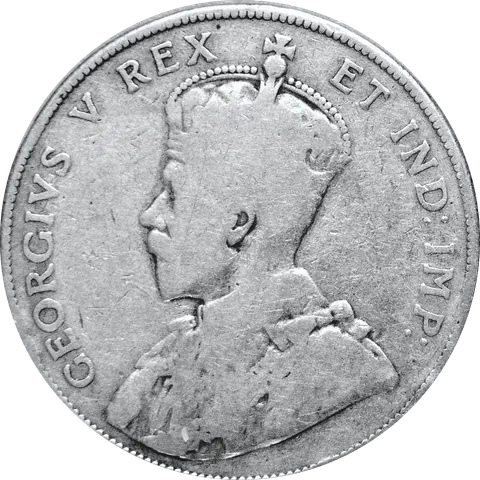
Canadian 50 Cents (Sterling Silver)
1870–19190.3456 oz Ag
$16.34Face value 50 cents
Sources & methodologyNGC, Numista, Wikipedia
Specifications verified against
- Wikipedia: Ten-dollar coin (Canada)1912-1914, 16.72 g, 90% gold 10% copper, 26.92 mm, designers
- NGC: Canada 10 Dollars KM 27 Prices & ValuesGold 0.9000, weight 16.7185 g, AGW 0.4838 oz, 26.92 mm; mintages 1912-1914
- Numista: 10 Dollars - George V, Canada16.72 g, actual gold weight 0.484 oz
Method
Melt values are calculated from these specifications and the price of gold and the other metals in its alloy; no value is stored or copied from another site. See the methodology and data sources.
Image
- Obverse and reverse: American Numismatic Society, 1913.104.1 (Gold 10 dollar of George V, Canada, 1912). Public domain. Source · Public domain
- Background removed and resized; otherwise unaltered.